

Business Central connects
you to your business
Microsoft Dynamics 365 Business Central unifies your business bringing together finance and operations, sales and marketing with a comprehensive and modern business management software solution. Integration with applications such as payroll, banking apps, and custom apps then becomes easy.
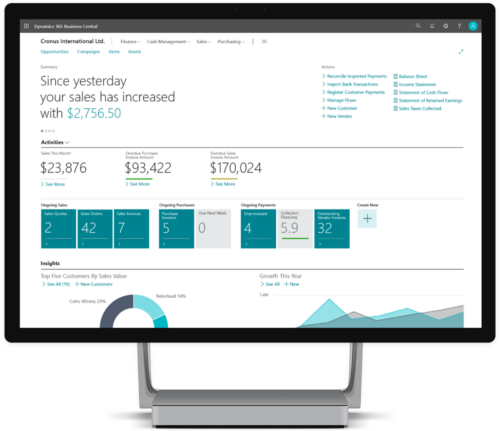
Microsoft Business Central allows you to build a complete picture of your business with easy-to-create dashboards and built-in analytics; proactively informing and guiding employees. Centralise your data from finance, sales, service, and operations to get an accurate end-to-end view of your business. With Microsoft Business Central, all data stays up to date, so you can spot trends, prevent issues, and deliver great customer experiences.
Microsoft Dynamics 365 Business Central streamlines the reporting process across your business by combining Microsoft’s market-leading ERP, CRM, and BI software solutions with the power of working from the cloud, allowing you to make better decisions, faster.
Microsoft Dynamics 365 Business Central helps you
make smarter decisions
When data is scattered across an organisation, creating and configuring reports becomes complicated and often doesn’t provide the information we need about cash flow, inventory, and customers. Increasingly, companies are searching for ways to make reporting less complicated and time-consuming.
Microsoft Dynamics 365 Business Central is a revolutionary business management software system that is designed to provide your company with the tools it needs to stay organised and competitive.
Microsoft Dynamics 365 Business Central streamlines the reporting process across your business by combining Microsoft’s market-leading ERP, CRM, and BI software solutions with the power of working from the cloud, allowing you to make better decisions, faster.
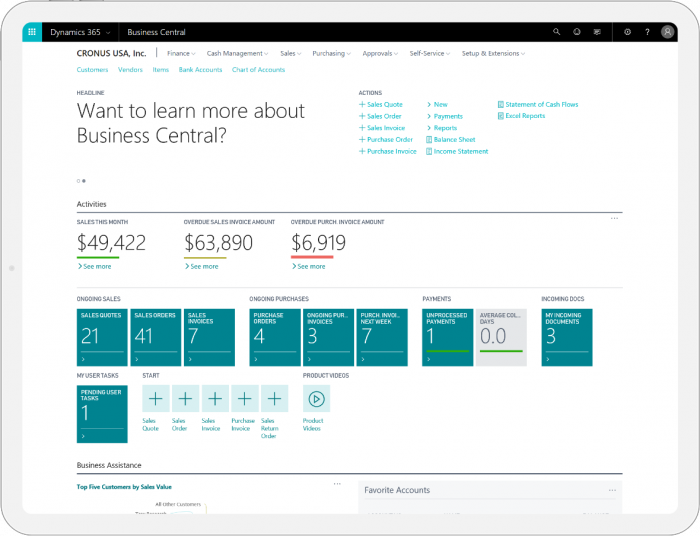
Sell smarter and improve customer service using Microsoft Business Central
Configurable dashboards and multidimensional reports enhance analysis of key performance indicators (KPIs), inventory, sales, and order status. Easily track ongoing sales performance and leverage actionable insights to focus on customers that have the greatest potential for long-term growth. Gain a comprehensive overview of your service tasks, workloads, and employee skills to effectively assign resources and accelerate case resolution.
For more information on the benefits of Microsoft Dynamics 365 Business Central, pricing, or support please contact us, or book a demo today.
If you know what you want and would like a quote for Dynamics 365 Business Central that’s tailored to your business, scroll down to pricing.
Cloud Security
Business Central runs on Microsoft Azure, the world leader in cloud computing. Azure provides secure, reliable, scalable data centres around the globe, allowing companies like yours to store, process, and analyse information without the worry of losing critical data. With Business Central, you can enjoy the benefits of the cloud while still maintaining control over your data.
Cloud technology provides your organisation with a new level of flexibility in terms of your employees being able to access Business Central securely wherever they are. It is a huge advantage in today’s post-pandemic world. Nothing gives you more advantage these days than the ability to facilitate working from home or hybrid working models without losing out on productivity, security or access.
Real-Time Reporting
Microsoft Dynamics 365 Business Central is a powerful business software that gives businesses the flexibility and security they need to make informed decisions.
With this cloud-based business management suite, all your data is instantly available for accurate and timely reports. Reports can be shared with employees to help them make informed decisions faster, as it allows business owners or shareholders to easily see the current status at a glance.
How we can help
We offer this comprehensive financial management solution that helps your business achieve scale and success. Microsoft Business Central ERP solution integrates seamlessly with other aspects of your business, allowing you to streamline processes and maximise efficiency.
From implementation to ongoing support, we work hard to provide an excellent user experience that meets or exceeds client expectations.
We have years of experience in the finance industry, ensuring that our solutions are tailored to meet your specific needs.
If you are in need of flexible, efficient business management software, Microsoft Business Central may be perfect for you. Get in touch with us to find out more and arrange a demo.
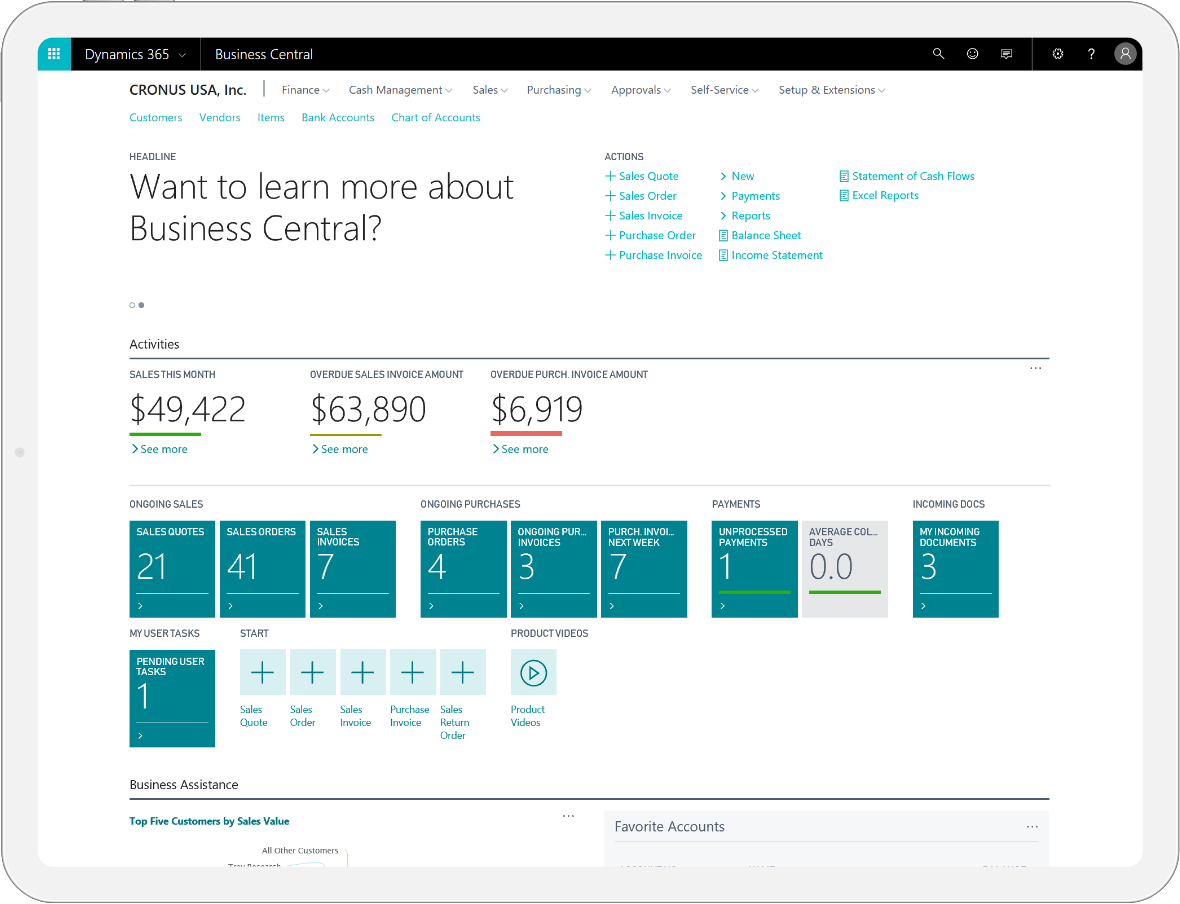
Microsoft Business Central
Functionality
This business management software is what your business needs to ensure clarity of decision making, providing business insight for senior leaders across your organisation, and a simple to use platform for end users.
How much are Microsoft Business Central Licences?
There are three types of Microsoft Business Central licences you may wish to purchase for your organisation – the costs* are indicated below.
Business Central
Essentials licence
£57.50 PCM
This licence is a named subscription user license. It gives an individual full access to the essential application areas within Microsoft Business Central.
Features
- Financial Management
- Supply Chain Management
- Customer Relationships
- Human Resources Management
Business Central
Premium licence
£82.80 PCM
Premium licences provide access to all areas within the Essentials license of Microsoft Business Central, with the two extra functional areas of Manufacturing, and Service Management.
Features
- Service Management
- Manufacturing
Business Central
Team Member licence
£6.60 PCM
This licence is a named subscription license, assigned to someone who does not require full user capabilities.
Features
- Financial Management
- Supply Chain Management
- Customer Relationships
- Human Resources Management
* Prices are correct as at 1st May 2023
What’s the cost of
Business Central?
In less than five minutes by answering a few simple questions, you can get an estimate of monthly costs and onboarding/implementation fees.

Standard Solution
BC SaaS - Base Configuration Plus
1 Company
Solution configured to checklist
Bespoke Chart of Accounts
Standard P&L and Balance Sheet
Dimensions & Analysis by Dimensions
Basic Fixed Assets
Basic Permissions and Roles Setup
Data Migration - Rapid Start & Opening Balances for Finance
Basic Training
Access to set of reports and Dashboard (requires Power BI account)
Implementation support